AI support tools for benefits managers are defined as AI-powered platforms and assistants that automate administrative tasks, answer employee questions, and orchestrate workflows across HR and benefits systems. Platforms like bswift's Emma Intelligence and UKG People Assist represent the current standard for what benefits administration solutions can accomplish. Nearly half of managers are already experimenting with AI, compared to only 26% of employees, which positions benefits managers as the critical leverage point for organization-wide adoption. Organizations offering AI training grew from 40% in 2024 to 47% in 2025, and the pace is accelerating. If you manage benefits for a mid-size or enterprise organization, the question is no longer whether to adopt AI tools for HR. It is which tools to deploy first, and how to govern them responsibly.
1. Automation of routine administrative tasks
AI for employee benefits starts with eliminating the work that consumes the most time without requiring human judgment. Eligibility checks, data entry, plan updates, and enrollment confirmations are all tasks that AI handles faster and with fewer errors than manual processes. bswift's Emma Intelligence improves data accuracy by 30 to 40% and saves hundreds of administrative hours per year. That accuracy gain matters because benefits data errors create compliance exposure and employee frustration simultaneously.
When AI handles intake and data validation automatically, your team shifts from reactive correction to proactive planning. Benefits managers who have deployed automation report reclaiming significant time for vendor negotiations, plan design reviews, and workforce analytics. The operational shift is real and measurable.

Pro Tip: Before deploying any benefits management software with AI automation, audit your current data quality. AI amplifies what is already in your system. Clean data produces accurate outputs; dirty data produces confident errors.
2. Instant resolution of employee benefits questions
The most visible win from AI support tools is the speed at which employees get answers. Emma Intelligence resolves 80% or more of employee questions instantly, without routing them to a benefits specialist. That resolution rate means your team handles only the genuinely complex cases that require human judgment.
Employees asking about deductibles, dependent coverage, or FSA balances at 9 PM on a Sunday now get accurate, plan-specific answers immediately. This is not a marginal improvement. It changes the employee experience of benefits entirely. When employees trust that they can get fast, correct answers, benefits utilization and satisfaction scores both rise.
The practical implication for benefits managers is that your support queue shrinks while employee confidence in the benefits program grows. You spend less time on repetitive Q&A and more time on the strategic decisions that actually require your expertise.
3. Guided enrollment with personalized plan recommendations
AI-powered enrollment tools do more than display plan options. They guide employees through decision points with personalized recommendations based on their household size, health history inputs, and financial preferences. Emma EnrollPro reduces enrollment time by 75%, which directly reduces the support burden during open enrollment periods.
Jellyvision's ALEX is another example of a benefits communication tool that uses conversational AI to walk employees through plan comparisons in plain language. The result is fewer enrollment errors, fewer post-enrollment correction requests, and higher confidence among employees that they chose the right plan. Personalized guidance at scale is something no benefits team can replicate manually.
Here is a comparison of traditional enrollment versus AI-guided enrollment:
| Factor | Traditional enrollment | AI-guided enrollment |
|---|---|---|
| Time per employee | 20 to 40 minutes | 5 to 10 minutes |
| Plan comparison support | Static PDFs or call center | Real-time personalized guidance |
| Error rate | Higher due to manual input | Reduced by automated validation |
| After-hours availability | None | 24/7 |
| Scalability | Limited by staff capacity | Scales with employee volume |
Pro Tip: Trigger AI-guided enrollment communications automatically when a qualifying life event is detected, such as a marriage or new dependent. Automated, event-driven outreach dramatically reduces the window where employees make uninformed decisions.
4. Real-time data syncing and eligibility management
Benefits administration solutions that use AI maintain continuous synchronization between HR systems, payroll platforms, and carrier data feeds. This eliminates the lag between an employee's status change and their benefits eligibility update. Manual reconciliation processes that once took days now happen in real time.
Automated eligibility management also reduces the risk of employees receiving benefits they are no longer entitled to, or being denied coverage they should have. Both scenarios create legal and reputational risk for the organization. AI-driven syncing closes those gaps without requiring your team to run manual audits after every payroll cycle.
For benefits managers overseeing large, distributed workforces, real-time data accuracy is not a convenience. It is a compliance requirement. AI tools that connect directly to HRIS platforms like Workday or SAP SuccessFactors make that accuracy achievable at scale.
5. Agentic workflow orchestration across HR systems
The most significant shift in AI in human resources is the move from question-answering bots to agents that execute multi-step workflows. UKG People Assist now orchestrates work conversationally across HR, payroll, and IT service systems through Google Cloud's Gemini Enterprise Agent Gallery. An employee can request onboarding setup through a chat interface, and the agent triggers provisioning, benefits enrollment, and payroll configuration across separate systems without human intervention.
"AI tools are evolving from simple question-answering bots to agents capable of initiating and completing complex HR workflows autonomously." — UKG People Assist capabilities, April 2026
This distinction matters for benefits managers because agentic workflow execution means AI is no longer just a reference tool. It becomes an operational participant. A new hire's benefits enrollment can be triggered, completed, and confirmed without a single manual touchpoint from your team.
Pro Tip: Map your highest-volume, multi-system workflows before selecting an agentic AI platform. The tools that deliver the most value are those that connect the specific systems your team already uses, not those with the longest feature list.
6. Improved communication and employee engagement
AI-powered benefits communication tools send targeted, personalized messages based on employee behavior and plan data. If an employee has not completed their HSA contribution setup, the system sends a specific prompt. If a dependent's coverage is expiring, the employee receives an automated alert with instructions. This level of personalization was previously only possible with dedicated communication staff.
Platforms like bswift embed communication triggers directly into the benefits administration workflow. When an enrollment change is detected, the system automatically generates confirmation messages, next-step guidance, and deadline reminders. The result is a benefits experience that feels attentive and organized, which reflects directly on your team's reputation within the organization.
Employee engagement with benefits programs increases when communication is timely and relevant. AI makes that consistency achievable without adding headcount.
7. Governance frameworks and AI risk management
Only 43% of organizations have formal AI risk frameworks in place, and only 44% have completed AI impact assessments. That governance gap is a direct risk for benefits managers, because AI tools that provide incorrect guidance on health coverage or retirement contributions create both legal liability and employee harm.
Benefits managers must insist on formal risk documentation before scaling any AI deployment. The governance checklist should include:
- AI risk framework: Written policies covering acceptable use, escalation paths, and error correction protocols
- Impact assessment: Documentation of how AI outputs affect employee decisions and what happens when the AI is wrong
- Privacy controls: Verification that the platform meets HIPAA and applicable state privacy requirements
- Audit trail: Logging of AI interactions for compliance review and dispute resolution
- Human override protocol: Clear process for benefits specialists to correct or override AI outputs
Governance is not a compliance checkbox. It is the operational foundation that determines whether your AI deployment builds or destroys employee trust. AI risk management practices that are built before scaling are far easier to maintain than those retrofitted after problems emerge.
8. Manager enablement as the adoption multiplier
Only 14% of managers report no challenges driving effective AI use within their teams. That statistic means 86% of managers face real friction when trying to lead AI adoption. For benefits managers, that friction shows up as team members who distrust AI outputs, employees who bypass AI tools and call the benefits line anyway, and leadership who cannot measure the ROI of the deployment.
A manager-first enablement model addresses this directly. It involves creating tailored playbooks that cover how to use specific AI tools, when to escalate to a human specialist, and how to interpret AI-generated recommendations. Gartner's research identifies emotional resistance coaching and impact communication support as the two most underprovided capabilities in current AI training programs.
The AI adoption strategies that succeed treat managers as the primary change agents, not just end users. When you understand the tool deeply enough to coach your team through resistance, adoption rates rise and the AI investment delivers its projected return.
9. Freeing capacity for strategic benefits design
When AI handles routine administration and employee Q&A, benefits managers gain time for the work that actually differentiates a benefits program. Vendor contract analysis, plan design benchmarking, workforce health trend review, and mental health benefit expansion all require human judgment and strategic thinking. AI cannot do this work. But it can clear the calendar space for you to do it.
AI tools that eliminate repetitive tasks allow employees and managers to focus on creative ideation and higher-value engagement. For benefits managers specifically, that means shifting from being a transaction processor to being a strategic advisor on workforce wellbeing. That shift is both professionally rewarding and organizationally valuable.
The benefits managers who will lead their organizations in 2026 and beyond are those who use AI to handle volume while they focus on strategy. The tools exist. The question is whether you are using them.
Key takeaways
AI support tools deliver measurable gains for benefits managers across automation, accuracy, employee experience, and strategic capacity, but only when paired with governance and manager enablement.
| Point | Details |
|---|---|
| Automation reduces errors | AI platforms like bswift improve data accuracy by 30 to 40% and save hundreds of admin hours annually. |
| Enrollment speed increases | AI-guided enrollment tools reduce time per employee by up to 75%, cutting support burden during open enrollment. |
| Governance gaps are real | Only 43% of organizations have formal AI risk frameworks, creating compliance exposure benefits managers must address. |
| Managers drive adoption | With 86% of managers facing AI adoption challenges, tailored enablement playbooks are required for successful deployment. |
| Agentic AI changes operations | Tools like UKG People Assist now execute multi-system workflows conversationally, moving beyond simple Q&A functions. |
Why manager-first AI enablement is the only strategy that works
I have watched organizations deploy expensive AI platforms and see adoption stall at 20% because no one built the manager layer. The technology works. The gap is almost always human. Benefits managers who treat AI deployment as a software rollout rather than a change management initiative consistently underperform those who invest in their own fluency first.
The uncomfortable truth about AI tools for HR is that the ROI calculation only holds if employees actually use the tools. And employees use tools when their manager understands them, advocates for them, and can answer basic questions about how they work. That requires you to go deeper than a vendor demo.
What I have found actually works is building a small internal playbook before launch. Document three to five scenarios where the AI handles the full interaction, two to three scenarios where a human must step in, and one clear escalation path for edge cases. That playbook does more for adoption than any training video. It also surfaces governance gaps before they become incidents.
The AI ticket management practices that translate best to benefits administration are the ones that treat every AI interaction as a logged, reviewable event. When your team knows that AI outputs are auditable, they trust the system more and escalate appropriately when something looks wrong. That combination of trust and accountability is what separates a successful AI deployment from a cautionary tale.
Start with governance. Build the playbook. Then scale.
— Dizzy
How Coevy helps benefits managers scale AI support
Benefits managers need AI support tools that grow with their organization without creating new operational complexity. Coevy is built for exactly that challenge.
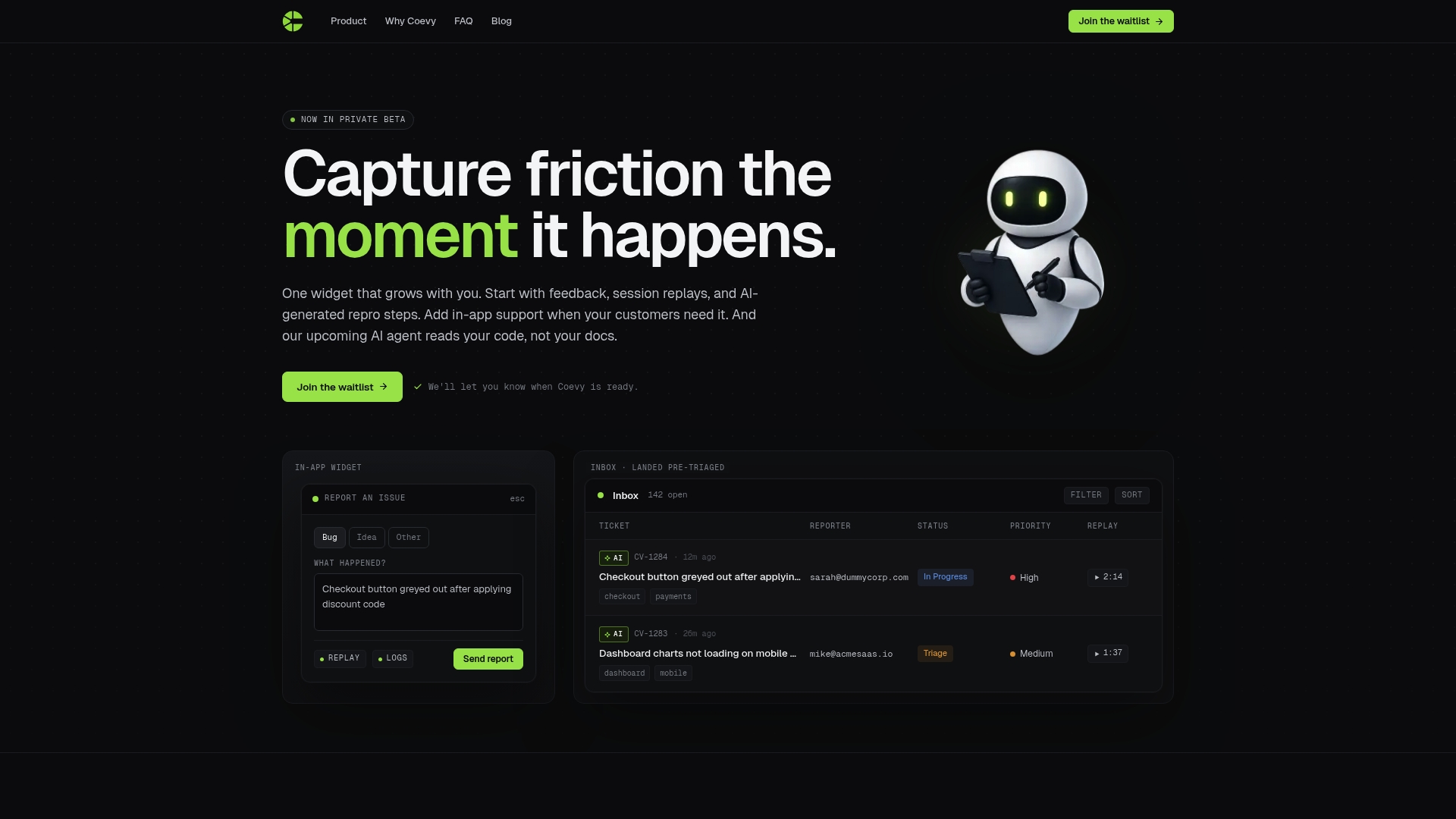
Coevy's AI-powered platform captures employee friction the moment it happens, attaches contextual data automatically, and routes issues to the right resolution path without manual triage. For benefits teams managing high volumes of employee questions and support requests, Coevy reduces the back-and-forth that slows resolution and erodes employee confidence. The platform scales from initial feedback collection through full AI-powered support without requiring a rebuild as your team grows. If you are evaluating benefits administration solutions with serious AI capabilities, Coevy is worth a close look.
FAQ
What are AI support tools for benefits managers?
AI support tools for benefits managers are platforms that automate administrative tasks, answer employee benefits questions instantly, and orchestrate workflows across HR and payroll systems. Examples include bswift's Emma Intelligence and UKG People Assist.
How much time can AI save during open enrollment?
AI-guided enrollment platforms like Emma EnrollPro reduce per-employee enrollment time by up to 75%, which significantly cuts the support volume benefits teams handle during open enrollment periods.
What governance steps should benefits managers take before deploying AI?
Benefits managers should require a formal AI risk framework, a completed impact assessment, HIPAA-compliant privacy controls, and a documented human override protocol before scaling any AI tool across the benefits function.
Why do so many AI deployments in HR fail to reach full adoption?
Only 14% of managers report no challenges driving AI use effectively, according to Gartner's July 2025 research. The primary barriers are emotional resistance from employees, insufficient manager training, and the absence of clear escalation protocols.
Can AI tools handle complex benefits questions or only simple FAQs?
Current AI platforms resolve more than 80% of employee questions instantly, including plan-specific guidance. Complex cases involving legal interpretation or unique employee circumstances still require human specialist review.