AI agents are autonomous software programs that perceive context, reason over it, and take actions across tools and systems without requiring a human to click through each step. For small SaaS teams, they are the difference between a two-person support queue drowning in password reset tickets and a lean operation where humans handle only the conversations that genuinely require judgment. The industry term for this category is agentic AI, and understanding how it applies to your specific workflows is what separates teams that scale from teams that stall. Platforms like Pendo Novus and tools built on retrieval-augmented generation (RAG) architectures already show what's possible: faster releases, fewer bugs reaching users, and support queues that shrink without adding headcount.
How AI agents optimize customer support for small SaaS teams
Customer support is where most small SaaS teams feel the squeeze first. A five-person team cannot staff a 24/7 queue, yet users expect answers in minutes, not hours. AI agents solve this by classifying incoming tickets, resolving the most common ones autonomously, and escalating only the cases that need a human.
The numbers from real deployments are striking. One SaaS platform with 15,000 users saw 72% ticket deflection after deploying an AI support agent trained on 18 months of historical tickets and knowledge base articles. Monthly human-handled tickets dropped from 1,400 to 392, and first response time fell from 4.2 hours to under 90 seconds. Customer satisfaction held at 4.6 out of 5. That result means a small support team can redirect most of its week toward retention conversations and product feedback instead of answering the same billing question for the hundredth time.

The highest-impact starting point is not a general chatbot. Training on top recurring intents such as password resets, refund requests, and how-to questions, and then tracking per-intent deflection rates, produces measurably better outcomes than optimizing a blended deflection score. You know exactly where the agent is working and where it is failing.
Three practices separate high-performing support agents from ones that frustrate users:
- Ground the agent to approved knowledge. Responses must come from your documentation, not the model's general training data.
- Design generous escalation paths. Any signal of user frustration or an out-of-scope question should trigger a clean handoff to a human, with full conversation context attached.
- Define a handoff contract. The handoff to humans should specify what the agent knows versus what it inferred, so your support rep does not start from scratch.
Pro Tip: Before you launch an AI support agent, pull your last three months of tickets and identify the top 15 recurring intents. Build and test the agent against those intents first. You will see ROI within weeks, not quarters.
In what ways do AI agents enhance SaaS product development workflows?
Support is the obvious entry point, but the productivity gains from agentic AI extend deep into product and engineering operations. This is where small SaaS teams often leave the most value on the table.
Pendo's Novus product agent connects directly to a codebase and continuously monitors product changes, flags UX and code issues with root-cause narratives, and prepares approval-based fix plans and rollout instrumentation. The critical distinction here is that Novus delivers fix plans and narratives, not raw data dumps. A small team does not have time to interpret charts. They need the agent to say: "This pull request introduces a regression in the onboarding flow affecting mobile users on iOS 17. Here is the proposed fix. Approve to proceed." That shifts the human role from bug detective to decision-maker.
For small SaaS teams, this model produces three concrete benefits:
- Faster release cycles. Pre-merge issue detection means fewer bugs reach production, reducing the costly cycle of hotfixes and user complaints.
- Smarter collaboration. Engineers and product managers work from the same agent-generated narrative, cutting alignment meetings.
- Reduced cognitive load. Monitoring is continuous and automated, so no one has to remember to check dashboards before a deploy.
The contrast with a human-only workflow is sharp. Without an agent, a two-person product team spends significant time on monitoring, triage, and documentation that an agent can handle in seconds. AI should amplify existing workflows to multiply output per employee, and product and engineering are typically the best starting points for that amplification.
Pro Tip: Start with one workflow: pre-merge code review or post-deploy UX monitoring. Measure the time your team spent on that task before and after. A single workflow win builds the internal confidence to expand.
What architectures make AI agent deployment safe and effective?
The biggest misconception about agentic AI is that agents automatically do the right thing. They do not. Starting narrow with clear metrics and explicit escalation protocols is what separates a successful deployment from an expensive mistake.
A safe and effective architecture for small SaaS teams rests on three technical pillars:
- Retrieval-augmented generation (RAG). The agent retrieves answers from your approved knowledge base rather than hallucinating from general training data. This keeps responses accurate and auditable.
- Tool calling with constrained permissions. The agent can call APIs and write to systems, but only within explicitly defined boundaries. It cannot, for example, issue a refund above a certain threshold without human approval.
- Typed operational memory. Separating typed memory from inference and enforcing explicit approval boundaries maintains reliability when agents perform sensitive writebacks.
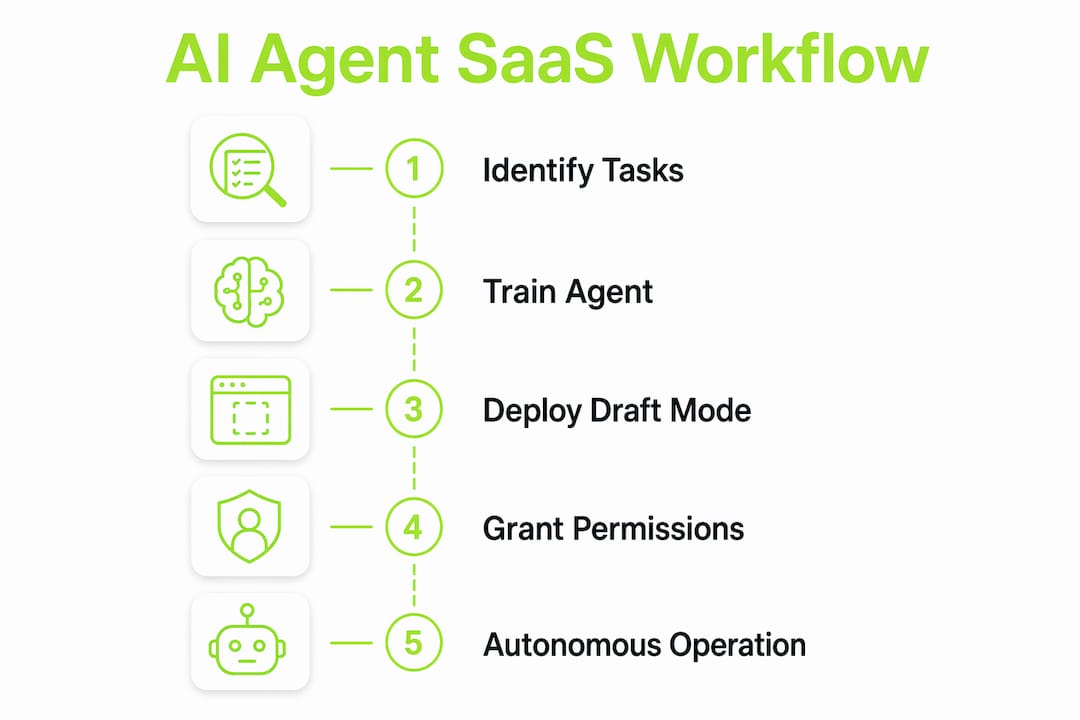
The phased rollout approach that consistently works looks like this:
- Audit your documents, data, and top workflows. Identify the highest-ROI candidates.
- Build the agent and test it internally. Run it in draft mode where it generates responses but does not send them.
- Supervised dogfooding: your team reviews every output before it reaches users.
- Graduated autonomy: grant full autonomy only for the simplest, highest-confidence intents. Keep human approval gates for everything else.
| Deployment phase | Human involvement | Agent permission level |
|---|---|---|
| Internal draft mode | Reviews every output | Read-only, no sends |
| Supervised rollout | Approves before sending | Limited writeback |
| Graduated autonomy | Monitors edge cases | Full autonomy on simple intents |
| Full production | Oversight and calibration | Scoped by intent type |
Phased deployment with draft-mode output followed by incremental permission granting minimizes risk and accelerates learning. Teams that skip this sequence and deploy agents with full autonomy on day one typically spend months cleaning up trust damage with their users.
Pro Tip: Run your agent in draft mode for at least two weeks before it sends a single message autonomously. The patterns you catch during that window will prevent the errors that destroy user trust.
How do AI agents shift team roles and operating models?
Adopting AI agents is not just a technology decision. It is an organizational one. The teams that extract the most value from agentic AI redesign roles before they change headcount.
The clearest evidence of what this looks like at scale comes from McKinsey, which deployed 25,000 AI agents focused on research synthesis and document generation, saving 1.5 million hours in a single year. That is the equivalent of roughly 750 full-time employees. Total output increased by 10%. Human roles shifted from producing first drafts to reviewing, calibrating, and making judgment calls.
For a small SaaS team, the math scales down but the pattern holds. A support rep who previously handled 80 tickets a day now handles 20, but those 20 are the complex, high-stakes conversations that require empathy and product knowledge. A sales rep who spent 40% of their week on CRM updates and meeting prep can redirect that time to customer relationships. AI can automate 60 to 70% of routine sales and service tasks, reducing administrative overhead from 40% of a rep's week to 15 to 20%.
The metrics worth tracking when you deploy AI agents include:
- Ticket deflection rate by intent, not just overall deflection
- Time-to-resolution for escalated tickets (this should improve as agents handle the easy cases)
- Output per employee in product and engineering workflows
- Recontact rate (users who come back with the same issue signal agent failure)
"ROI from AI agents comes from workflow redesign and system integration, not just adding chatbots or isolated features. Measure before and after baselines for any deployment." — How AI Reshapes SaaS Operating Model
The strategic advice here is direct: redesign the role before you consider whether you need fewer people. Teams that use AI agents to do more with the same headcount consistently outperform teams that use them to justify cuts.
What practical steps help small SaaS teams implement AI agents?
Implementation does not require a dedicated AI team or a six-month project. It requires a structured approach and a willingness to start small.
- Conduct a task audit. List every recurring task your team performs weekly. Flag anything that is rule-based, repetitive, or involves retrieving information and formatting a response. These are your automation candidates.
- Select tools that integrate with your existing stack. Your AI agent needs to connect to your CRM, your product analytics platform, and your communication tools. Agents that operate in isolation from your data produce generic, low-value outputs.
- Run a pilot with draft-mode output. Pick one workflow, one intent, or one team. Ship drafters with limited writeback permissions and review every output for two weeks before granting autonomy.
- Measure against a baseline. You cannot know if the agent is working unless you recorded how long the task took before deployment. Time-to-answer, ticket volume, and output per employee are the three metrics that matter most at the start.
- Iterate and expand. Once one workflow is stable and measurably better, apply the same process to the next highest-ROI candidate.
For teams building AI into their customer support workflows, the fastest path to value is a support agent trained on your actual documentation and ticket history, not a generic chatbot layered on top of a third-party knowledge base.
Pro Tip: Use your task audit to rank candidates by two criteria: frequency and rule-based predictability. The top of that list is where your first AI agent should live.
Key takeaways
AI agents deliver measurable value for small SaaS teams when deployed in narrow, well-defined workflows with clear metrics, human escalation paths, and phased permission grants.
| Point | Details |
|---|---|
| Start with top support intents | Train agents on the 10 to 20 most frequent ticket types to see deflection gains within weeks. |
| Use phased deployment | Draft mode followed by supervised rollout prevents trust-damaging errors in production. |
| Redesign roles before headcount | Use agent capacity gains to redirect humans to judgment-heavy, high-value work. |
| Measure per-intent, not blended | Per-intent deflection and recontact rates reveal where agents succeed and where they fail. |
| Architecture determines reliability | RAG grounding, constrained permissions, and typed memory are non-negotiable for safe agents. |
The part most founders get wrong about AI agents
I have watched a lot of small SaaS teams approach AI agents the same way they approached their first marketing automation tool: they plug it in, set it loose, and wait for results. That almost never works.
The teams that get real value from agentic AI treat the first deployment as a learning exercise, not a solution. They pick one workflow, instrument it carefully, and accept that the agent will be wrong sometimes. That tolerance for imperfection in a controlled environment is what builds the calibration data you need to trust the agent with more autonomy later.
The cultural shift is just as important as the technical one. Your support rep needs to trust that the agent's escalations are meaningful, not noise. Your engineer needs to believe the agent's code review flags are worth reading. That trust is earned through transparency, not through marketing the agent internally as infallible. Show your team the draft outputs. Let them correct the agent. Make them part of the calibration process.
The founders I find most effective with AI agents have stopped thinking of themselves as managers of people doing tasks and started thinking of themselves as supervisors of systems that produce outputs. That is a different skill set, and it is worth developing deliberately. The teams that build that capability now will have a structural advantage that compounds every year.
— Dizzy
How Coevy helps small SaaS teams deploy AI agents that actually work
Small SaaS teams need AI agent infrastructure that fits their product from day one, not a generic chatbot bolted onto a help center.
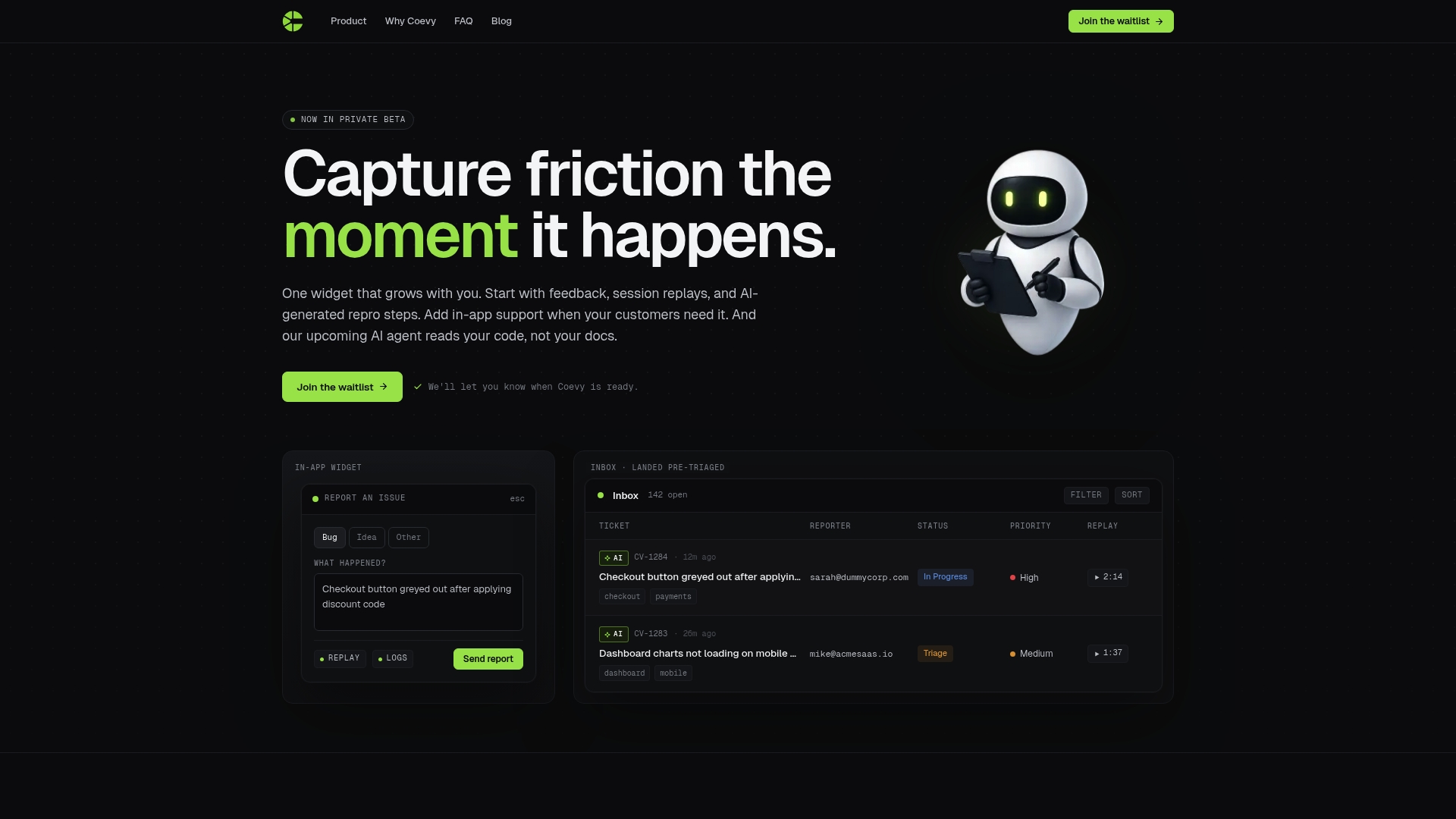
Coevy is built specifically for this. Its integrated widget captures user feedback, session replays, and AI-generated bug reproduction steps directly inside your web app, giving any AI agent you deploy the contextual data it needs to resolve issues accurately. Coevy's codebase-aware AI reads your actual source code rather than relying on documentation alone, which means support answers are grounded in what your product actually does. Auto-tagging, prioritization, and clean escalation paths are built in. For teams ready to move from reactive support to AI-driven support workflows, Coevy provides the foundation to do it safely and measurably. See how it works at coevy.com.
FAQ
How do AI agents assist small SaaS teams specifically?
AI agents handle repetitive, rule-based tasks such as ticket classification, password resets, and CRM updates, freeing small teams to focus on product development and high-value customer conversations. The most effective deployments start with the top 10 to 20 recurring support intents and expand from there.
What ticket deflection rates can small SaaS teams realistically expect?
A well-trained AI support agent can achieve 72% ticket deflection while maintaining customer satisfaction scores above 4.5 out of 5, based on a four-week deployment at a SaaS platform with 15,000 users.
What is the safest way to deploy an AI agent for the first time?
Start in draft mode with read-only permissions, review every output for at least two weeks, and grant autonomy only after the agent demonstrates consistent accuracy on your highest-frequency intents. This phased deployment approach prevents the trust-damaging errors that come from granting full autonomy too early.
How do AI agents change roles in a small SaaS team?
AI agents shift human work from first-draft and triage tasks to review, judgment, and relationship management. McKinsey's deployment of 25,000 agents saved 1.5 million hours annually while increasing total output by 10%, a pattern that scales down proportionally for small teams.
Do AI agents work for product development as well as customer support?
Yes. Agents like Pendo Novus connect to codebases to monitor pull requests, flag UX regressions, and generate fix plans with human approval gates, reducing the time engineers spend on monitoring and triage while accelerating release cycles.