In-app feedback is defined as user input collected directly inside a product interface at the exact moment a user encounters friction, confusion, or a bug. This real-time capture is the core mechanism behind how in-app feedback reduces support load: it gives product and support teams the raw signal to fix issues before they generate tickets. Teams that pair conversational root-cause research with proactive product fixes cut recurring-issue ticket volume by 20–40% within 30–60 days. Add AI-powered embedded support to that loop, and 80% of help inquiries resolve without a human agent ever getting involved. The result is a support operation that spends less time firefighting and more time on work that actually moves the product forward.
How in-app feedback reduces support tickets: the core mechanisms
In-app feedback works differently from post-use surveys or email follow-ups because it captures the user's exact state at the moment of failure. A user who hits a confusing workflow and submits feedback from inside that screen sends you the page URL, their account state, and the action they just attempted. That context collapses the diagnostic cycle from days to minutes.
Four mechanisms drive the ticket reduction:
- Root-cause clustering. Feedback submitted at friction points groups naturally around the same broken flows. When ten users report confusion on the same settings screen, that cluster is a product bug or UX gap, not ten individual support issues. Fix the root cause once, and you retire the entire cluster.
- Proactive product fixes. Proactive root-cause analysis prevents tickets by eliminating product gaps upstream, before users reach the support queue. Reactive ticket handling, by contrast, addresses the same problem repeatedly at higher cost.
- Contextual in-app guidance. Delivering help based on a user's exact workflow state, rather than pointing them to a documentation site, reduces "how-to" tickets by 30–50% within 60 days. That is a direct reduction in your support queue, not a reroute.
- AI-powered autonomous resolution. Embedding AI support inside the product flow resolves the majority of inquiries without escalation. That same approach reduces customer churn by 11%, which means fewer frustrated users leaving and fewer angry tickets arriving.
The cost math reinforces the case. Self-service resolution costs between $0.50 and $2.37 per issue. Live human interaction costs $8–$35 for the same resolution. Shifting even a fraction of your ticket volume to self-service produces measurable savings within a single quarter.
Pro Tip: Trigger feedback prompts immediately after a failed action, not after a successful one. Users who just hit an error are motivated to tell you exactly what went wrong. Users who just succeeded have nothing to report.

What are the most common pitfalls in in-app feedback programs?
Most in-app feedback programs fail not because the tool is wrong, but because the team measures the wrong outcome. The most dangerous mistake is optimizing for ticket deflection instead of ticket resolution.
- False deflection. AI may suppress 45% of customer queries, but only about 14% reach full self-service resolution. That 31-percentage-point gap represents users who gave up, not users who got answers. Churn follows.
- Generic feedback inboxes. Collecting feedback without attaching product context, such as the user's current screen, account tier, or workflow step, produces vague reports that cannot be mapped to a specific fix. "The app is confusing" tells you nothing actionable.
- NPS as a diagnostic tool. Net Promoter Score measures sentiment, not root cause. A score of 6 tells you a user is unhappy. It does not tell you which screen broke their workflow or which error message sent them to your support queue. Sentiment data and diagnostic feedback serve different purposes and should never be conflated.
- Brittle screenshot tools. Pixel-based screenshot capture for in-app help breaks easily on UI changes. Every time your team ships a redesign, the guidance breaks. Metadata-based tools that capture UI state through CSS selectors and component identifiers are far more resilient.
- Poor AI-to-human handoff. An AI that confidently gives a wrong answer is worse than no AI at all. Confidence-based AI routing that transfers uncertain queries to a human agent with full conversation context improves customer satisfaction and reduces churn by up to 20%.
Pro Tip: Audit your deflection metrics quarterly. If your "deflected" ticket count is rising but your resolution rate is flat, you are hiding problems, not solving them.
How to implement an in-app feedback program that cuts support demand
A feedback program that actually reduces support load requires deliberate design at every stage, from where prompts appear to how fixes get measured after deployment.
- Map your friction points before placing prompts. Pull your top 10 ticket categories from the past 90 days. Each category corresponds to a product area where users are failing. Place feedback triggers at those exact screens and workflow steps, not on your homepage or after a successful action.
- Use conversational AI to interview affected users. Conversational AI interviewers that ask affected users detailed follow-up questions enable faster and more accurate root-cause discovery than conventional one-question surveys. Ask "What were you trying to do?" and "What did you expect to happen?" to get diagnostic signal, not just sentiment.
- Cluster feedback by ticket category, then assign fixes. Map each feedback cluster to the ticket category it generates. When a fix ships, track whether that ticket category declines. This closes the loop between product work and support outcomes.
- Embed contextual self-help based on user state. Contextual delivery of help at the moment of need reduces resolution time by 25–50% compared with sending users to a separate documentation site. Build help content that triggers based on the user's current screen and action, not based on a keyword search.
- Start AI support with high-volume, low-complexity queries. Password resets, billing questions, and feature location questions are ideal first targets. Build accuracy on these before expanding AI coverage to complex technical issues. This protects your CSAT score while you scale.
- Monitor and adjust as the product evolves. Feedback programs go stale when the product ships new features. Schedule a monthly review of your top feedback clusters and compare them against your current ticket categories. Gaps between the two signal areas where your feedback triggers need updating.
The comparison between a feedback program built on these steps versus a generic "submit feedback" button is significant. A generic inbox collects noise. A context-triggered, AI-clustered, fix-linked program produces a measurable decline in support ticket volume within one to two quarters.
Platforms like Coevy are built around this exact workflow. Coevy captures in-app feedback with session context attached automatically, so every report arrives with the reproduction steps, screen state, and user context your team needs to act without back-and-forth.
What is the strategic impact of in-app feedback on SaaS support teams?
The downstream effects of a well-run in-app feedback program extend well beyond ticket counts. Support teams that shift from reactive handling to proactive prevention operate differently, and the difference shows up in both cost and customer experience.
"Embedding AI-powered support in the product flow resolves 80% of help inquiries autonomously and reduces customer churn by 11%. That means fewer users leaving because they could not get help, and fewer tickets arriving because the product answered the question before the user had to ask."
First contact resolution rates improve because agents receive tickets with full context attached. A ticket that arrives with a session replay, the user's exact workflow state, and AI-generated reproduction steps takes minutes to resolve, not hours. That efficiency compounds across a team of ten agents handling hundreds of tickets per week.
Support teams also shift their focus. When AI and contextual guidance handle the high-volume, low-complexity tier, human agents concentrate on complex issues that require judgment, empathy, and product expertise. That shift improves agent satisfaction and reduces turnover, which is a hidden cost most support leaders undercount.
The AI-human handoff model that routes uncertain queries to humans with full context is central to this. Confidence-based routing prevents the frustration that comes from an AI giving a confident but wrong answer. Done correctly, it produces a CSAT improvement alongside the cost reduction, not a tradeoff between the two.
SaaS teams that have embedded feedback and AI support at scale report that their support cost per user declines as the product grows, rather than rising in proportion to the user base. That is the structural advantage in-app feedback programs create: support that gets more efficient as the product matures.
Key Takeaways
In-app feedback reduces support load by capturing friction in context, enabling proactive fixes, and delivering targeted self-help that prevents tickets before they form.
| Point | Details |
|---|---|
| Capture feedback in context | Trigger prompts at friction points to collect screen state, user action, and workflow data automatically. |
| Fix root causes, not symptoms | Cluster feedback by ticket category and ship fixes that retire entire recurring-issue groups at once. |
| Measure resolution, not deflection | Track whether users actually got answers, not just whether they stopped submitting tickets. |
| Use AI for high-volume, low-complexity queries | Start AI coverage on simple, repeatable questions to build accuracy before expanding scope. |
| Link feedback loops to support metrics | Compare ticket category volume before and after each product fix to confirm real reduction. |
The metric that most teams get wrong
Most product managers I have worked with track deflection as their primary success metric for in-app feedback programs. That is the wrong number. Deflection tells you how many users did not submit a ticket. It does not tell you whether those users got what they needed or simply gave up and churned.
The teams that get the most out of in-app feedback programs are the ones that obsess over resolution rate, not deflection rate. They ask: did the user complete the task they came to do? Did the product fix reduce the ticket category it was supposed to retire? Did the AI answer actually match the user's question, or did it produce a confident-sounding non-answer?
The other thing I see underestimated is the compounding effect of context. A feedback program that captures session replays and UI state alongside the user's written report is not just more useful for debugging. It changes the entire support conversation. Agents stop asking "Can you reproduce the issue?" and start solving. That single change, across hundreds of tickets per week, is worth more than any deflection metric.
The emerging trend worth watching is AI agents that read actual product codebases rather than documentation. Coevy's upcoming AI agent is built on this model. When the AI understands the code, not just the help articles, it can answer questions that documentation-based systems cannot. That is where the next wave of support load reduction comes from.
Embed feedback deeply into your product operations culture. Treat every ticket cluster as a product failure, not a support problem. That mindset shift is what separates teams that reduce support load durably from teams that manage it forever.
— Dizzy
Coevy's approach to capturing friction before it becomes a ticket
Product and support teams that want to act on in-app feedback without building a custom pipeline have a direct path forward with Coevy. Coevy's integrated widget captures user feedback, session replays, and AI-generated reproduction steps inside your web app, so every report arrives with the context your team needs to act immediately.
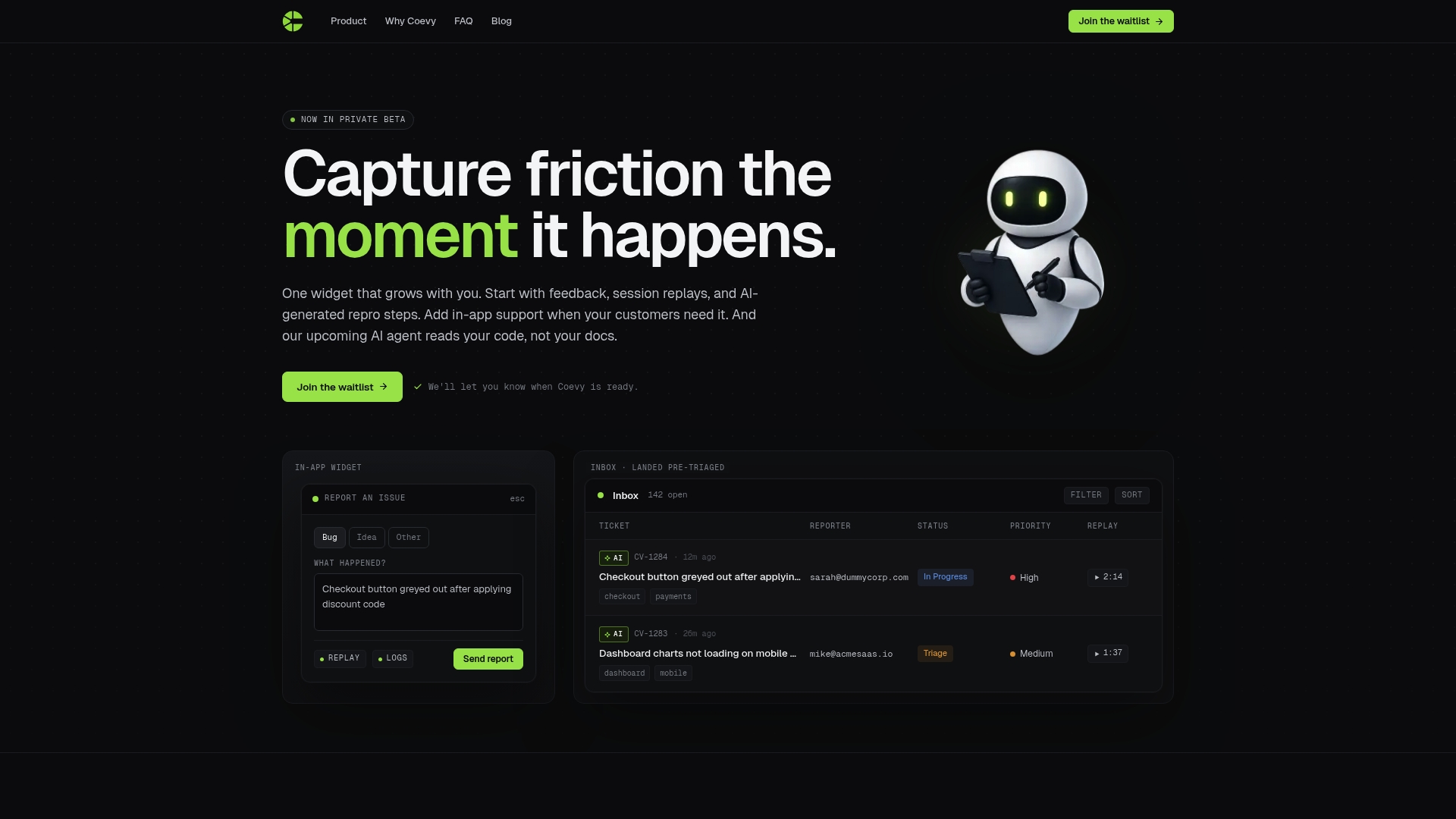
Coevy's AI-powered auto-tagging and prioritization cluster incoming feedback by issue type automatically, which maps directly to the root-cause workflow described in this article. The platform also supports in-app support without engineering overhead, making it practical for teams at any stage. If your goal is to reduce ticket volume while improving the user experience your product delivers, Coevy's platform is built for exactly that workflow.
FAQ
What is in-app feedback and how does it differ from surveys?
In-app feedback is collected inside the product at the moment of user friction, with screen state and session context attached automatically. Post-use surveys collect sentiment after the fact, without the diagnostic context needed to identify root causes.
How quickly can in-app feedback reduce support ticket volume?
Teams that pair conversational root-cause research with proactive product fixes see recurring ticket volume drop by 20–40% within 30–60 days of implementing targeted fixes.
What is the difference between ticket deflection and ticket resolution?
Deflection counts users who did not submit a ticket. Resolution confirms those users actually completed their task. AI can suppress 45% of queries while only resolving 14%, meaning the gap represents users who gave up, not users who succeeded.
How does contextual in-app guidance reduce support load?
Contextual guidance delivers help based on the user's exact screen and workflow state. This approach cuts "how-to" ticket volume by 30–50% within 60 days and reduces resolution time by 25–50% compared with separate documentation lookup.
What role does AI play in reducing support load through in-app feedback?
AI clusters feedback into root-cause groups, routes low-complexity queries to autonomous resolution, and hands off uncertain queries to human agents with full context. Done correctly, this model reduces churn by up to 20% while improving customer satisfaction scores.