An integrated support and feedback platform is software that centralizes customer support requests and feedback from multiple channels into a unified workspace, replacing scattered email threads, forms, and chat logs with one system. The industry term for the underlying discipline is feedback management, and the best platforms extend it into full support execution. Product and support teams in software development waste hours every week reconciling data from disconnected tools. A unified platform eliminates that waste by connecting feedback intake, issue tracking, and resolution into a single workflow. Coevy is one example of this category, built specifically for SaaS teams that need feedback collection, session replays, and AI-powered bug reproduction in one embedded widget.
What is an integrated support and feedback platform?
An integrated support and feedback platform unifies collection, organization, analysis, and execution of support requests and user feedback from multiple channels into one centralized workspace. The key word is execution. Most teams already collect feedback. The gap is acting on it without losing context or creating extra work.
The architecture replaces fragmented processes with a centralized inbox and feedback database. Email, in-app widgets, chat, SMS, social media, and public reviews all feed into the same system. Support agents and product managers see the same data, tagged and prioritized, without switching tools.

This matters because knowledge silos between support and product teams are one of the most common causes of repeated bugs. A support agent closes a ticket. The product team never hears about the underlying issue. The bug resurfaces in the next sprint. A unified platform breaks that cycle by making every resolved ticket visible to the people who build the product.
The standard industry term for the collection and analysis layer is a feedback management system. The best platforms go further, adding task ownership, status tracking, and AI-driven prioritization on top of that foundation.
Core components every platform should include
- Centralized inbox: All support channels feed one queue. No duplicate tickets, no missed messages.
- Feedback database: Structured storage for user input, tagged by topic, sentiment, and product area.
- Workflow integration: Feedback converts directly into tasks with assigned owners and due dates.
- Multi-channel coverage: Email, chat, in-app widgets, SMS, and review platforms all connect natively.
- Reporting and analytics: Teams track resolution time, sentiment trends, and recurring issue frequency.
Pro Tip: Map every channel your users currently use to contact support before choosing a platform. A system that misses one major channel creates a new silo instead of eliminating existing ones.
How does AI enhance integrated support and feedback platforms in 2026?
AI is the feature that separates modern integrated customer support solutions from older ticketing systems. Advanced AI platforms can autonomously resolve up to 80% of routine customer issues, handling FAQs, booking requests, and status updates without agent intervention. That number represents a fundamental shift in how support teams allocate their time.
The AI layer works best when it is built into the platform from the start, not added afterward. Bolted-on AI frequently fails because it lacks deep integration with workflow data, product logs, and CRM records. A platform with native AI reads support tickets, session data, and product interaction history together, giving it the context needed to resolve issues accurately.
Modern integrated feedback engines use proprietary Large Language Models trained on product feedback patterns to translate unstructured user input into prioritized action items. They incorporate hallucination detection to ensure insights reflect actual user behavior, not AI inference. That distinction matters when product roadmap decisions depend on the output.
The practical result for product and support teams is a system that flags which issues are growing in frequency, which users are at risk of churning, and which bugs need immediate escalation. Teams that rely on AI-first customer support architectures spend less time triaging and more time resolving the issues that actually require human judgment.
Coevy takes this further with a codebase-aware AI agent that reads actual source code rather than static documentation. That approach produces debugging assistance tied directly to the application, not generic answers drawn from help articles.
What AI cannot do without proper data readiness
AI autonomous resolution requires the platform to ingest product logs, support tickets, and CRM data together. High-performing integrated platforms need this data readiness before AI can resolve issues with real context. Teams that skip this preparation get an AI layer that answers surface-level questions but misses the root causes that drive repeat contacts.
What are the benefits of integrating support and feedback for product teams?
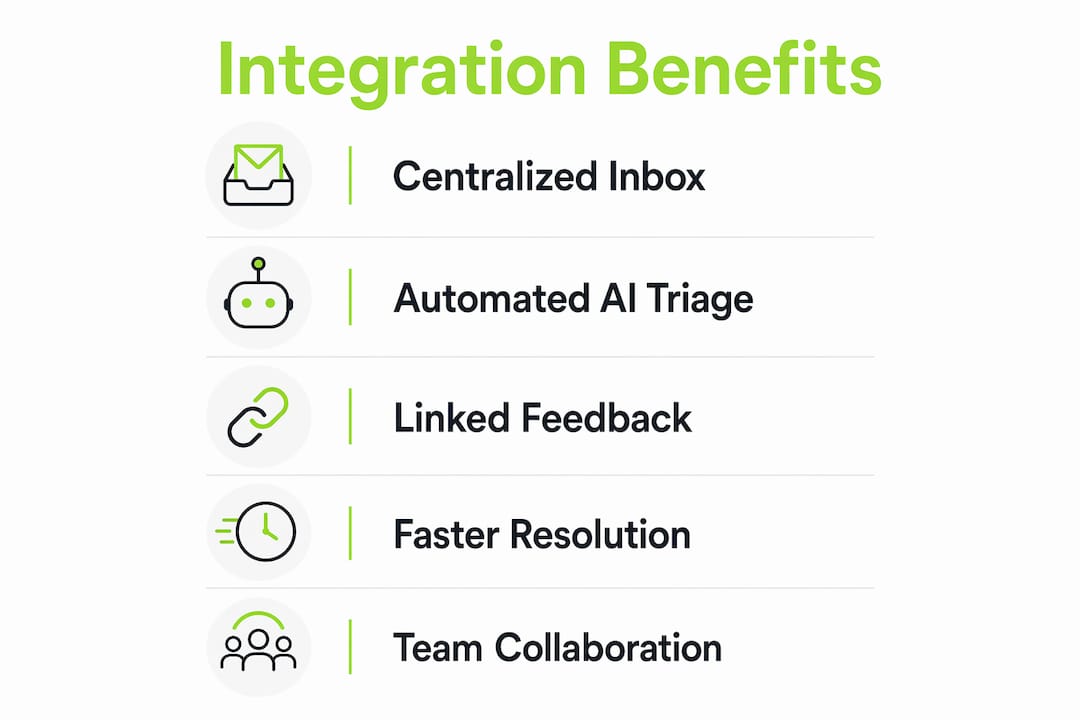
The clearest benefit is the elimination of repeated issue handling. Linking support tickets to product feedback loops with automatic task creation prevents the same bug from being resolved by support five times without the product team ever fixing it. That single workflow change reduces support volume and improves product quality at the same time.
The second benefit is speed. Optimal platforms capture sentiment and resolve concerns within minutes of a user reporting an issue. Slow feedback channels let operational problems escalate into negative public reviews. A low-friction in-app widget captures the complaint before the user opens the app store.
The third benefit is accountability. Centralizing feedback intake, prioritization, discussion, and execution gives teams full visibility and a clear path from feedback to resolution. Nothing gets lost in an email thread. Every piece of feedback has an owner, a status, and a deadline.
- Eliminate knowledge silos. Support and product teams share one data source, so bugs reported to support automatically reach the engineers who can fix them.
- Reduce response time. Centralized queues and AI triage cut the time between a user reporting an issue and a team member acting on it.
- Convert feedback into tasks. Platforms that tie feedback to task ownership prevent the common failure of collecting insights that never influence the product.
- Prevent public escalation. Real-time feedback capture resolves concerns before they become one-star reviews.
- Track product improvement over time. Recurring issue frequency shows whether fixes are working or whether the same problem keeps returning.
Pro Tip: Set a rule that any support ticket tagged as a bug automatically creates a linked task in your product management tool. That single automation closes the loop between support resolution and product development without requiring manual handoffs.
How to implement an integrated support and feedback platform effectively?
Implementation fails most often because teams underestimate how fragmented their current setup is. Start by auditing every channel users currently use to reach support or submit feedback. Email inboxes, Slack channels, in-app forms, and public review platforms all count. The audit reveals which channels the new platform must cover on day one.
Choosing the right platform means prioritizing end-to-end workflow capability over feature count. A platform with 50 integrations but no native task creation still requires manual work to convert feedback into action. Look for systems that handle the full cycle: intake, triage, assignment, resolution, and reporting.
- Assess fragmentation first. List every tool currently handling support or feedback. Identify where data gets lost between handoffs.
- Require workflow integration. The platform must connect to your CRM, product analytics, and project management tools natively.
- Train teams on task conversion. Support agents need to know how to flag feedback for product review. Product managers need to know how to pull support data into sprint planning.
- Set baseline metrics before launch. Measure current resolution time, ticket volume, and repeat contact rate. You need a starting point to evaluate improvement.
- Review and adjust monthly. Platforms generate data. Teams that review it monthly catch emerging issues before they become crises.
Coevy's embedded widget approach addresses the fragmentation problem directly. It attaches session replay data and contextual information to every feedback submission automatically, so support teams receive reports with full context rather than vague descriptions. Teams exploring in-app feedback tools for SaaS products will find that embedded widgets consistently outperform standalone form-based systems for context richness.
The customer feedback loop only closes when feedback reaches the people who can act on it. Implementation is not complete until that path is tested and confirmed.
Key Takeaways
An integrated support and feedback platform delivers value only when feedback drives execution, not just collection.
| Point | Details |
|---|---|
| Unified workspace is the foundation | Centralizing all channels into one inbox eliminates data silos and prevents feedback loss. |
| AI requires data readiness | Autonomous resolution works only when the platform ingests product logs, tickets, and CRM data together. |
| Feedback must convert to tasks | Platforms that tie feedback to task ownership and status tracking produce better product outcomes than passive collection tools. |
| Real-time capture prevents escalation | Low-friction feedback channels resolve concerns before they become negative public reviews. |
| Audit fragmentation before implementing | Mapping current channels before choosing a platform prevents creating new silos alongside old ones. |
Why most teams are still doing this wrong
The most common mistake I see is treating a feedback platform as a collection tool rather than an execution system. Teams celebrate the volume of feedback they gather. They build dashboards. They share sentiment scores in all-hands meetings. Then nothing changes in the product, and users stop submitting feedback because they have learned it goes nowhere.
Treating feedback as passive rather than active leads directly to stagnation. The platforms that actually improve products are the ones that make it impossible to receive feedback without assigning it to someone. That sounds like a small process change. In practice, it rewires how product and support teams relate to each other.
The second mistake is deploying AI before the data is ready. I have watched teams integrate an AI layer into a platform that still runs on disconnected ticket queues and manual tagging. The AI produces confident-sounding summaries that do not reflect what users actually reported. Hallucination detection, as a built-in feature rather than an afterthought, is the only reliable safeguard against this.
The future of this category is platforms that read the actual product, not just the tickets about it. Coevy's direction with codebase-aware AI is the right one. When an AI agent can read source code and session replays together, it stops guessing and starts diagnosing. That is the version of integrated support worth building toward.
— Dizzy
How Coevy fits into your support and feedback workflow
Product and support teams that want to move from fragmented feedback collection to a fully connected workflow have a direct path with Coevy.
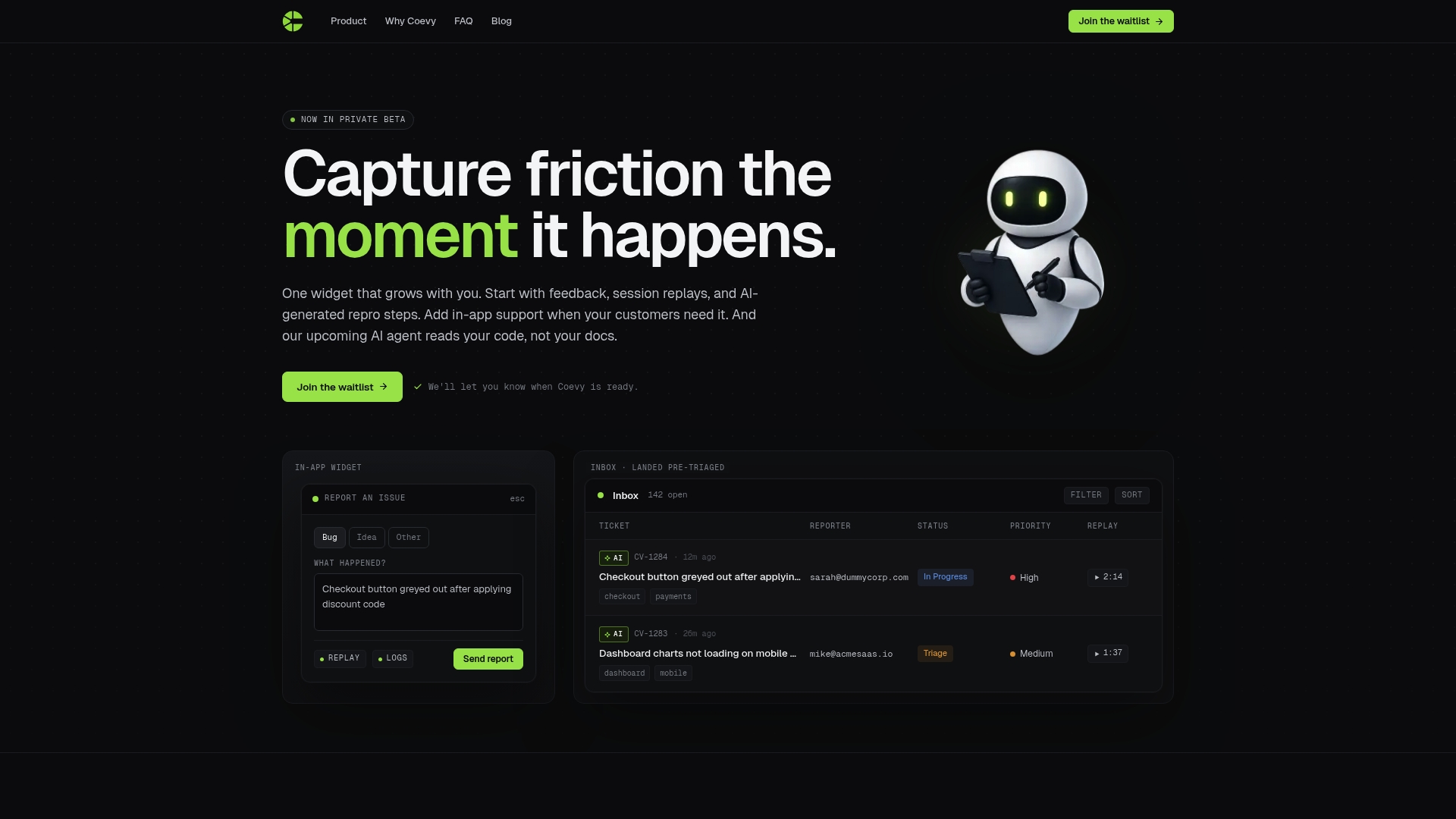
Coevy embeds directly into your web app as a widget, capturing user feedback, session replays, and AI-generated bug reproduction steps without requiring users to leave the product. Every submission arrives with contextual session data attached, so support teams spend less time asking follow-up questions and more time resolving issues. AI-powered auto-tagging and prioritization surface the most critical issues first. GDPR-compliant by design, with field masking and IP anonymization built in. For teams ready to connect customer feedback software to real product outcomes, Coevy is built for exactly that workflow.
FAQ
What is an integrated support and feedback platform?
An integrated support and feedback platform is software that centralizes support requests and user feedback from multiple channels into one workspace, connecting intake, triage, task assignment, and resolution in a single system.
How is this different from a basic ticketing system?
A basic ticketing system manages support requests. An integrated platform also captures product feedback, links tickets to development tasks, and uses AI to prioritize and resolve issues autonomously.
Can AI really resolve 80% of support issues automatically?
Advanced AI platforms can autonomously resolve up to 80% of routine requests, but only when the platform has ingested sufficient product, ticket, and CRM data to provide accurate context.
What features should product teams prioritize when choosing a platform?
Product teams should prioritize task conversion from feedback, workflow integration with their project management tools, AI-driven prioritization, and real-time in-app feedback capture with session context.
How does Coevy differ from standard feedback management systems?
Coevy attaches session replay data and AI-generated reproduction steps to every feedback submission automatically, and its upcoming codebase-aware AI agent reads actual source code rather than relying on documentation.