AI in product backlog management is defined as the application of machine learning, large language models, and predictive analytics to automate scoring, ranking, and continuous reordering of backlog items across dimensions like value, effort, risk, and strategic alignment. Product teams that adopt this approach stop treating the backlog as a static list and start treating it as a live decision system. Tools like Jira and Azure DevOps now embed AI features directly into sprint workflows, reducing the manual overhead that slows down refinement. The result is faster prioritization decisions, fewer mid-sprint surprises, and a backlog that reflects real business priorities rather than whoever shouted loudest in the last planning meeting.
How does AI improve backlog prioritization and scoring?
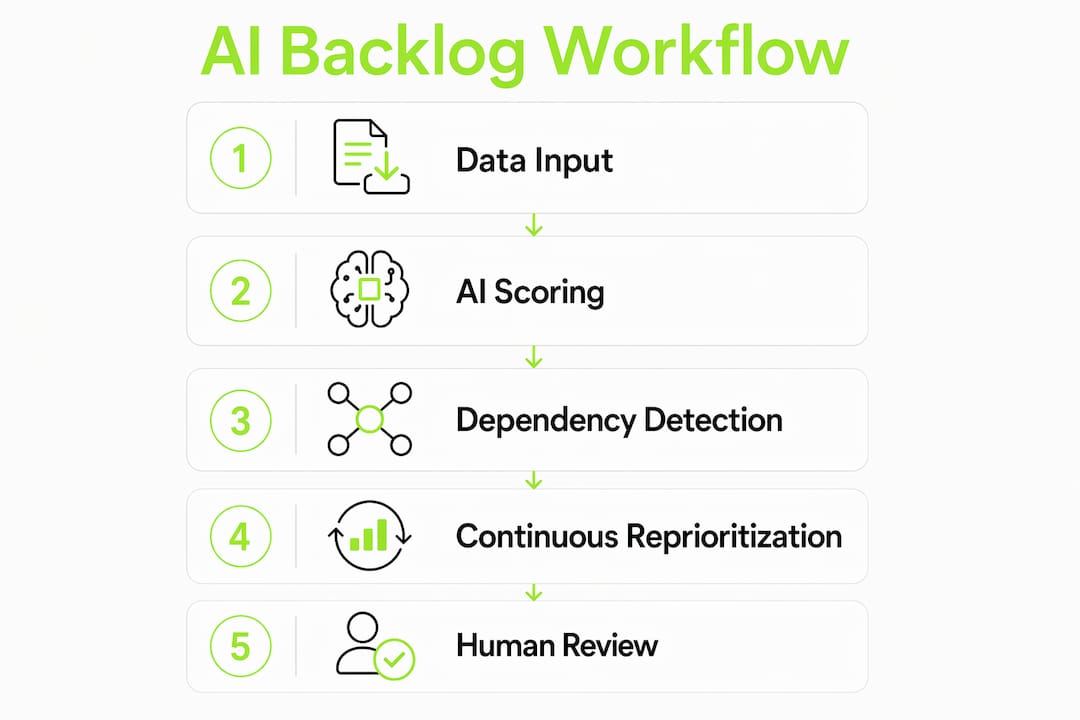
Traditional prioritization frameworks like RICE (Reach, Impact, Confidence, Effort) and WSJF (Weighted Shortest Job First) depend on human estimates that go stale the moment the sprint starts. AI changes that by continuously re-ranking backlog items based on live signals including customer feedback, historical delivery data, and working agreements. The model does not score once and forget. It recalculates as conditions change.
AI evaluates backlog items across multiple dimensions simultaneously:
- Business value: Revenue potential, customer impact, and alignment with the product roadmap
- Effort and risk: Complexity estimates drawn from historical velocity and similar past stories
- Dependencies: Relationships between items that affect sequencing
- Strategic fit: Alignment with user personas and product vision
Manual RICE scoring asks a product manager to estimate four numbers and multiply them. AI-powered scoring pulls those inputs from actual data. A team using Azure DevOps with an AI layer, for example, gets effort estimates calibrated against the last 20 sprints of delivery data rather than a gut check in a planning session.
The comparison matters because manual frameworks produce a snapshot. AI produces a continuously updated ranking. High-performing product teams use this to eliminate feature creep by automatically comparing new requests against the roadmap and user personas, flagging misaligned items before they pollute the backlog.

Pro Tip: Start by running AI scoring in parallel with your existing RICE or WSJF process for two sprints. Compare the outputs. The gaps between human estimates and AI scores reveal where your team's assumptions are drifting from reality.

| Scoring Dimension | Manual Framework | AI-Powered Approach |
|---|---|---|
| Effort estimation | Human gut check | Calibrated from sprint history |
| Value scoring | Stakeholder input | Customer usage and feedback data |
| Dependency detection | Manual review | NLP scanning of stories and docs |
| Re-ranking frequency | Per ceremony | Continuous, triggered by live signals |
How does AI detect dependencies and clean up backlog hygiene?
Dependency detection is one of the most underrated applications of AI in agile workflows. A product manager reviewing 200 backlog items cannot reliably spot every technical dependency buried in story descriptions. Natural language processing can. AI detects hidden dependencies between user stories and technical tasks, surfaces conflicts early, and prevents the mid-sprint surprises that derail delivery.
The hygiene benefits extend well beyond dependency mapping:
- Duplicate detection: NLP compares story titles, descriptions, and acceptance criteria to flag near-identical items that waste refinement time
- Auto-drafted user stories: AI generates story drafts and acceptance criteria from meeting transcripts, reducing the time between a customer conversation and a ready backlog item
- Stale item flagging: Items that have not moved in multiple sprints get surfaced automatically for review or removal
- Acceptance criteria refinement: AI checks whether criteria are testable and specific, catching vague language before it reaches the development team
NLP tools auto-drafting acceptance criteria from meeting transcripts show measurable improvements in story clarity and reduce rework rates. That matters because rework is expensive. A story that returns from development because the acceptance criteria were ambiguous costs the team two to three times the original effort.
The practical payoff is that product managers spend less time on mechanical grooming and more time on the decisions that actually require human judgment. Deciding whether to build a feature that serves 5% of users but represents a strategic partnership is not a task for an algorithm. Removing 40 duplicate stories from a 300-item backlog absolutely is.
Pro Tip: When setting up AI hygiene tools, configure the duplicate detection threshold carefully. Too strict and it misses real duplicates. Too loose and it flags legitimate variations of the same theme as duplicates, creating noise that erodes team trust in the system.
What are best practices for integrating AI into backlog workflows?
Adoption fails when AI tools require product managers to leave their existing workflow. The most effective integrations embed AI recommendations directly inside Jira tickets, Azure DevOps work items, or whatever tool the team already uses. Embedded AI in backlog tools changes team behavior immediately by reducing friction and aligning suggestions with existing workflows.
A stepwise adoption approach works better than a full rollout:
- Start with acceptance criteria drafting. This is low-risk, immediately visible, and saves time in every refinement session. Teams see the value within the first sprint.
- Add duplicate and stale item detection. Run this as a background process that surfaces findings in a weekly digest rather than interrupting the workflow with constant alerts.
- Introduce AI-assisted scoring. Layer in AI-generated effort and value scores alongside existing estimates. Do not replace human scores yet. Let the team compare and build confidence.
- Enable continuous re-ranking. Once the team trusts the scoring model, allow AI to reorder the backlog between ceremonies and alert the Product Owner only when a significant priority shift occurs.
- Measure and adjust. Track refinement cycle time, story rework rates, and sprint predictability before and after each integration step. Drop features that do not move the metrics.
The human-in-the-loop principle is non-negotiable at every stage. AI does not replace the Product Owner. Attempts to fully automate prioritization produce backlogs that look optimized on paper but miss the nuanced customer context that only a product manager carries. AI handles the mechanical work. Humans make the final call.
For teams using Coevy, the AI-powered bug prioritization workflow integrates directly with feedback collection, so issues surfaced by users feed into backlog scoring without a manual handoff step.
How is AI transforming continuous backlog decision-making?
The traditional backlog grooming ceremony happens once per sprint. By the time the team meets, the data driving prioritization is already a week old. AI-powered backlog management shifts this from periodic ceremonies to continuous decision systems that update rankings automatically based on real-time signals.
Those signals include customer usage patterns, support ticket spikes, competitor moves, and changes in engineering capacity. A sudden spike in support tickets around a specific feature tells the AI that a fix or improvement belongs higher in the backlog. A competitor shipping a key feature tells it that a strategic item needs to move up. The Product Owner gets an alert only when the shift is material, not a constant stream of micro-updates.
| Signal Type | Example | Backlog Impact |
|---|---|---|
| Support spike | 40 tickets in 48 hours on login flow | Bug fix moves to top 5 |
| Competitor release | Rival ships AI-powered search | Strategic feature accelerates |
| Capacity change | Two engineers out for two weeks | High-effort items deprioritized |
| Usage drop | Feature engagement falls 30% | Related items flagged for review |
Continuous reprioritization triggered by live signals gives teams faster time-to-decision and reduces mid-quarter roadmap revisions. That predictability matters to stakeholders who need to plan go-to-market activities around delivery dates.
Building AI literacy is now a required capability for product managers, not an optional skill. Teams that understand how their AI scoring model weighs inputs can tune it to reflect actual business priorities. Teams that treat it as a black box get outputs they cannot explain or defend in a planning meeting.
Key takeaways
AI transforms product backlog management by replacing static, ceremony-driven prioritization with continuous, data-driven decision systems that free product teams to focus on strategic judgment.
| Point | Details |
|---|---|
| AI scoring is continuous | Machine learning re-ranks backlog items in real time using live signals, not just sprint-cycle estimates. |
| NLP cleans the backlog | Natural language processing detects duplicates, flags dependencies, and drafts acceptance criteria automatically. |
| Embed AI in existing tools | Integrating AI inside Jira or Azure DevOps reduces adoption friction and drives faster behavioral change. |
| Human oversight is required | AI handles mechanical scoring; Product Owners must retain final authority on strategic prioritization calls. |
| Measure impact at each step | Track refinement cycle time and rework rates to confirm AI integration is delivering real improvement. |
Where AI augments judgment, not replaces it
I have watched teams make the same mistake twice: they get excited about AI-powered prioritization, flip it on, and then stop questioning the outputs. Within two sprints, the backlog looks clean and scored. Within two quarters, the team has shipped a string of technically correct features that nobody wanted.
The problem is not the AI. The problem is the assumption that a well-scored backlog is a well-prioritized backlog. Scoring and prioritization are not the same thing. Scoring is a calculation. Prioritization is a judgment call that weighs customer relationships, organizational politics, technical debt, and market timing simultaneously. No model trained on historical sprint data captures all of that.
What AI genuinely does well is remove the mechanical burden that exhausts product managers before they even get to the hard decisions. Grooming 300 items, hunting for duplicates, chasing engineers for effort estimates, writing acceptance criteria at 10 p.m. before a planning session. That work is real, it is draining, and it crowds out the thinking that actually moves a product forward.
My honest recommendation: treat AI as the analyst on your team who never sleeps. It processes the data, surfaces the patterns, and prepares the briefing. You make the call. Teams that adopt that mental model get the most out of AI-driven product management without losing the human judgment that separates good products from optimized ones. For teams curious about how AI support scales as the product grows, the AI support scaling guide from Coevy is worth reading alongside this one.
— Dizzy
How Coevy helps teams act on backlog signals faster
Product teams can only prioritize what they can see. Coevy captures user friction the moment it happens, embedding feedback collection, session replays, and AI-generated bug reproduction steps directly inside your web app. That means issues reach your backlog with full context attached, not a vague description filed three days after the fact.
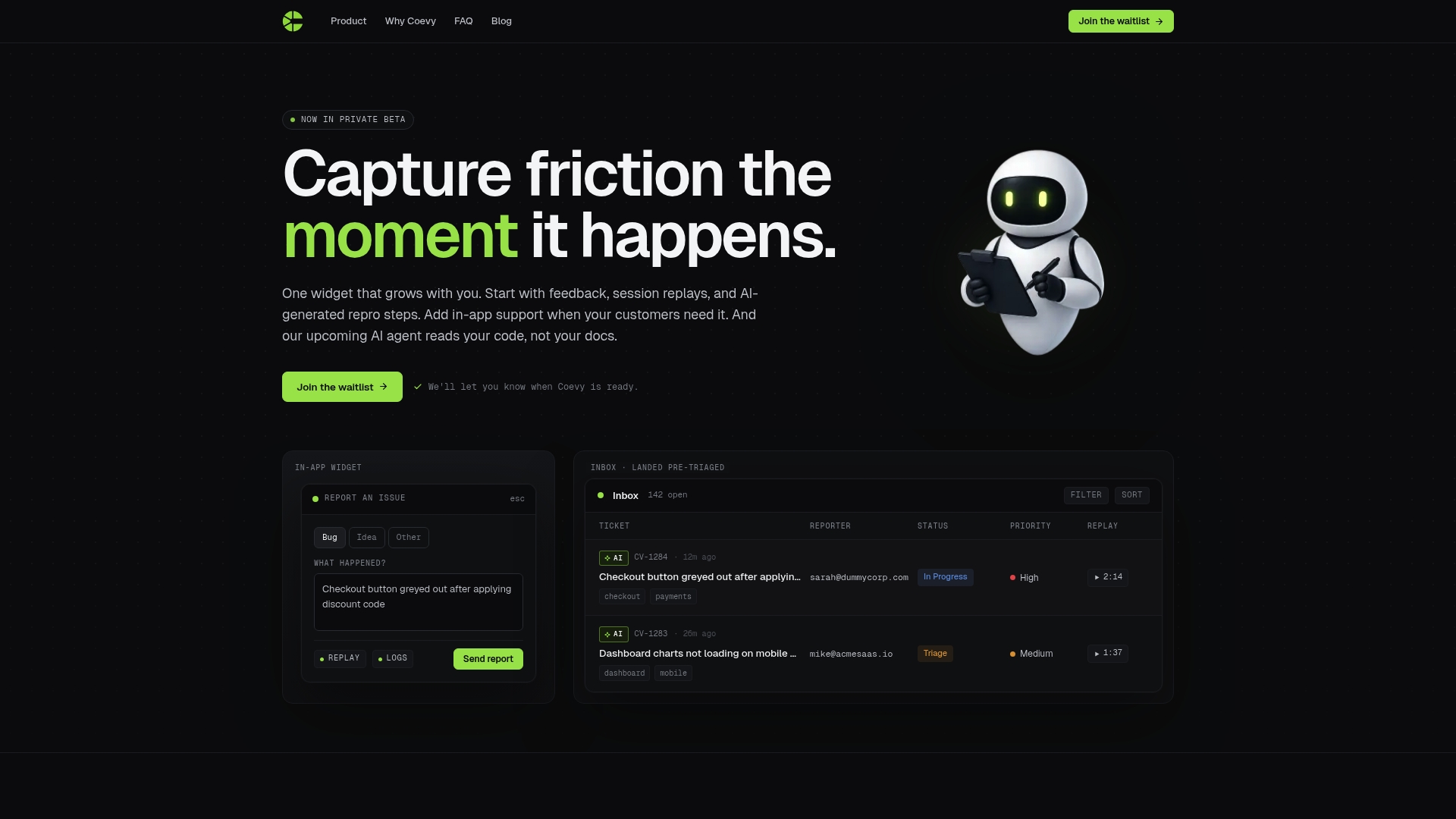
Coevy's AI-powered auto-tagging and prioritization features connect real user signals to your backlog workflow, so the items that matter most surface without manual triage. If you are building the AI literacy and tooling your team needs to manage a smarter backlog, start with Coevy and see how real-time friction capture changes what you build next.
FAQ
What is the role of AI in product backlog management?
AI automates scoring, dependency detection, and continuous re-ranking of backlog items using machine learning and predictive analytics. It shifts prioritization from a periodic ceremony to a live decision system updated by real-time signals.
How does AI differ from manual prioritization frameworks like RICE?
Manual frameworks like RICE rely on human estimates that go stale quickly. AI pulls scoring inputs from actual delivery history, customer feedback, and usage data, recalculating rankings as conditions change rather than once per sprint.
Will AI replace the product owner in agile teams?
AI does not replace the Product Owner. It automates mechanical tasks like scoring and duplicate detection, freeing Product Owners to focus on strategic decisions that require customer context and organizational judgment.
What is the best way to start integrating AI into backlog workflows?
Start with AI-drafted acceptance criteria. This is low-risk, immediately visible, and builds team confidence in AI outputs before you introduce more complex features like continuous re-ranking or automated dependency mapping.
How does AI prevent backlog bloat and feature creep?
AI compares new feature requests against the product roadmap, user personas, and existing items, flagging misaligned or duplicate requests automatically. This reduces the volume of low-value items that accumulate and slow down planning.